
Guest contributor Rogelio Rodríguez shares his thoughts on a sci-fi classic.
The Incredible Shrinking Man (1957)
written by Richard Matheson and Richard Alan Simmons
based on the novel The Shrinking Man by Richard Matheson
directed by Jack Arnold
The Incredible Shrinking Man aims to caution against the dangers of nuclear energy, but more importantly, it represents – in an extreme, fantastic, and highly entertaining way – what every man or woman goes through when a serious, limiting problem catches them off guard and extends over time.
One day, Scott Carey (Grant Williams) gets caught up in a “radioactive fog.” Weeks later, he notices his clothes are fitting a bit loose, and his wife, Louise (Randy Stuart), doesn’t need to tiptoe to kiss him anymore. Is he shrinking? By the end of the film, Scott is so small that he uses a pin as a spear to defend himself against a spider intent on devouring him, as if he were an insect. It’s an action-packed adventure, combined with a social, economic, and marital drama.
The Incredible Shrinking Man is a real B-movie gem. Now, B-movie gem doesn’t always mean a great film, but definitely one that’s definitely worth checking out. Here, the dialogue and acting may not be top-notch, but the special effects are ingenious, and the clever premise, taken from Richard Matheson’s novel of the same name, is skillfully directed by Jack Arnold—my favorite B-movie director from the ’50s (his best being 1954’s Creature from the Black Lagoon).
I’ve seen The Incredible Shrinking Man several times over the years, and I swear how you experience it changes depending on where you’re at in life.
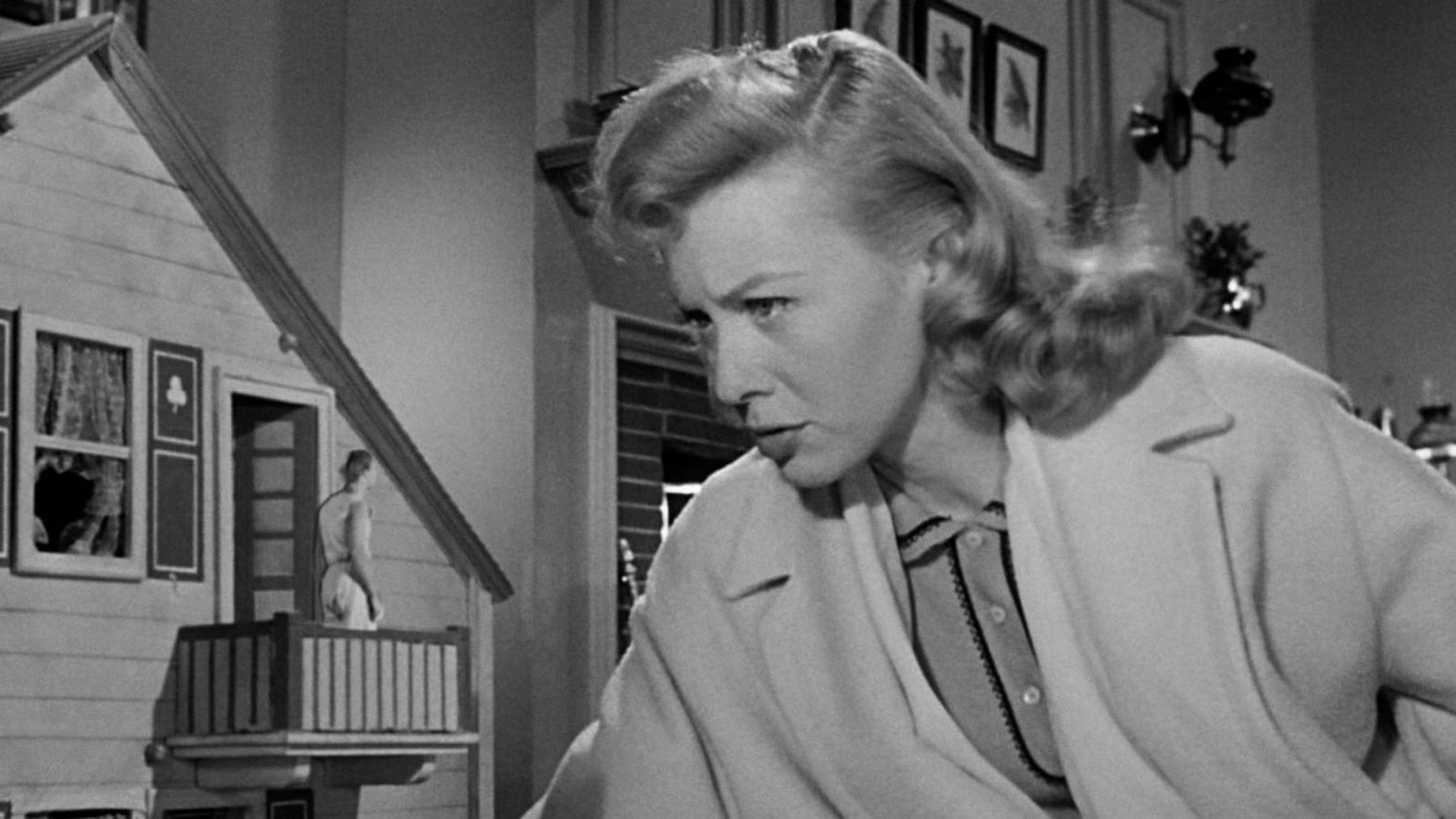
When you’re about eight, you totally get into the adventure of being tiny – sleeping in a dollhouse, running from a massive lion (actually just the house cat), and munching on cheese in a mousetrap that could kill you. That stuff’s pure excitement for a kid and sticks with you forever. During the parts with overly adult talk, I’d just drift off into my own little action scenes, seeing myself in Scott Carey’s new world and adding even more adventures: Flying on top of a bird, climbing spiderwebs like ladders, sailing paper boats—you name it.
Watching The Incredible Shrinking Man made me imagine situations like an overflowing bathtub. How would I handle that? It would seem like a tidal wave. The movie really gets you thinking about these big questions, even when you’re young. “So, to an ant, a little water spilled on the ground—is that a flood?”. “If there are beings way bigger than us in another planet, and they come to Earth, would we just get squashed by accident, like insects?” You start going down a rabbit hole of ideas.
As you hit your teens or early twenties, though, you start to nitpick. For example, Scott meets Clarice Bruce (April Kent), who’s supposed to have dwarfism. The producers cast a beautiful actress of normal height and used visual effects to make her look Scott’s size when he’s about three feet tall. Scott totally bonds with her and maybe even falls for her. Clarice tells him that she also lives in a world of giants, but that she’s happy. Of course, she’s lived thirty four years like this, and his situation is completely different. It’s quite a beautiful idea, with effective dialogues that would have been perfect if the actress had really been a dwarf. In fact, she didn’t even need to be pretty—Scott’s feelings for her weren’t about looks.

Later on it’s thrilling to see Scott, now just a couple of inches tall, run for his life as the house cat chases him. But then we see Scott as he tries to shut the (now) huge basement door to keep the cat out. The cat’s pushing from the other side, and they’re at it for what feels like ages. Technically, the scene’s well done and super exciting if you’re young and not thinking too hard about it. But didn’t the movie set up that Scott’s strength matches his size? So, how’s he holding his own against a cat? It’s like a regular-sized human going toe-to-toe with an elephant.
When you’re older and already know a bit about chemistry, physics, or radiation, it’s easier to start questioning those things as well. You may also add to your cinematic critique that some of the special effects look a bit… meh.
But then there’s watching The Incredible Shrinking Man as an adult.
Later in life, you understand that the VFX in The Incredible Shrinking Man are clever and more than adequate for its era and budget. You think about the 1950s and the H-bomb testing on Pacific islands – the US and the Soviet Union playing nuclear chicken while the world was still reeling from Hiroshima and Nagasaki – and it’s easier to forgive the film’s dubious speculation. Radiation effects were a bit of a mystery back then, and when we don’t know all the details we tend to mix science and fantasy, as this story does. And that’s fine.
The real beauty of The Incredible Shrinking Man, seen through adult eyes, isn’t its obvious commentary about the dangers of atom manipulation. It’s how the film explores what happens when life throws you a major curveball—like illness or an accident—and you lose your status, your job, your meaning (especially back in the 50s, when being the “man of the house” was everything). Scott thinks that if he keeps shrinking, he won’t be able to satisfy his wife sexually, keep his job, be a provider. Swap “shrinking” with your own life issue – imprisonment, unemployment, a lawsuit, or any other situation that leaves you shocked and powerless – and bam, you’re Scott Carey.

Scott finds solidarity with those who recognize his struggle. Dwarves have their own reasons for being small, totally different from Scott’s. But for a while, Scott feels a connection to Clarice deeper than the one he has with Louise (and that’s way more important than whether the actress was actually small or not). Scott loves his wife, and she loves him, but she can’t empathize with him.
As Scott gets smaller—literally, down to insect size—he actually grows as a person. When he’s alone, accidentally abandoned in the basement, the man who once pitied himself gets more resourceful and brave. Scott has to figure out how to survive in this weird new world: A matchbox becomes a bedroom, dinner consists of cake crumbs, and even a household spider (really a tarantula, because smaller spiders didn’t look good on camera) turns into his archenemy. No more pampering. No more whining. Scott’s physical size is reduced, but his self expands.
But his problem doesn’t stop there; it threatens to expand infinitesimally. And while Scott believes for most of the movie that he’s becoming less of a “man,” he finally gets that nature doesn’t revolve around him or even other humans. We’re just part of it. A part that can only try to make sense of it all. That makes him significant, no matter how tiny he may get.
Sure, Arnold was forced to change the word “nature” to “God” at the end of the movie, but you still understand what Scott Carey, or rather the author of the novel, Richard Matheson, really meant.
I leave you with the last words from The Incredible Shrinking Man, the movie:
“And I felt my body dwindling, melting, becoming nothing. My fears faded away, and in their place came acceptance. All this vast majesty of creation, it had to mean something. And I meant something too. Yes, smaller than the smallest, I meant something. For God, there is no zero. I still exist!”
And the novel:
“He stood again. Why had he never thought of it, of the microscopic and the submicroscopic worlds? That they existed he had always known. Yet never had he made the obvious connection. He’d always thought in terms of man’s own world and man’s own limited dimensions. He had presumed upon nature. For the inch was man’s concept, not nature’s. To a man, zero inches meant nothing. Zero meant nothing.
“But to nature there was no zero. Existence went on in endless cycles. It seemed so simple now. He would never disappear, because there was no point of non-existence in the universe. It frightened him at first. The idea of going on endlessly through one level of dimension after another was alien. Then he thought: If nature existed on endless levels, so also might intelligence.”
Rating: ***
Rogelio Rodríguez

 C i n e s t h e s I a